When Wang Lung was offered the option of selling his land so that his family could have the money, he shrieked: "I shall never sell the land!" and expresses his love for the land, refusing to sell it to the southerners, to whom he said: "Bit by bit I will dig up the fields and feed the earth itself to the children and when they die, I will bury them in the land, and I and my wife and my old father, even he, we will die on the land that has given us birth." (92)
Wang Lung was furious when he discovered that his son "ran under an old woman's arm who had come to buy it and seized it and ran into an alley and hid" and although "it was the first time they had had flesh to eat since they killed their own ox,"(118) Wang Lung "himself would have none of it,"(119) showing that he was an honorable man who would not accept stealing.
Indignant that his cousin had spoiled his own son by bringing him to a prostitute, he went to his uncle and complained that "[he had] harbored an ungrateful nest of snakes and they have bitten him,"(245) and that he explained that they were to leave and cause no more trouble.
Tuesday, September 30, 2008

Integrating Quotations
A quotation is any sentence, paragraph, phrase, words, taken word for word.
Basically 4 ways to integrate quotations:
1. Introduce the quotation with a complete sentence and a colon.
ex. Thoreau ends his essay with a metaphor: "Time is but the stream I go a-fishing in."
(Tip:If you use a complete sentence to introduce a quotation, you need a colon after the sentence.)
2. Us an introductory or explanatory phrase, but not a complete sentence, separated from the quotation with a comma.
ex. Thoreau asks, "Why should we live with such hurry and waste of life?"
(Tip: Use a comma to separate your own words from the quotation when your introductory or explanatory phrase ends with a verb such as "says," "said," "thinks," "believes," "pondered," "recalls" "questions," and "asks" (and many more.)
3. Make the quotation a part of your own sentence without any punctuation between your own words and the words you are quoting.
ex. Thoreau argues that "shams and delusions are esteemed for soundest truths, while reality is fabulous."
(Tip: notice that "that" replaces the comma. You can either add the word "that" or a comma after the verb "says" in phrases with "Thoreau says")
4. Use shorter quotations --- only a few words --- as part of your own sentence.
ex. Although Thoreau "drinks at" the stream of Time, he can "detect how shallow it is."
(Tip: When this method is used, no special punctuation is used. You should punctuate the rest of the sentence as you would if all the words where you own.)
All the methods are correct, but a variety should be used; do not use one method too much.
Wednesday, September 24, 2008
Unseemly
1. unseemly (adjective/adverb)
2. unseemliness
3. unseemly: a. (adj.) Not in good taste; improper; unbecoming. b. (adv.) In an unseemly manner. (Vocabulary for Achievement)
4. Nowadays, it is unseemly for one to refer to an African American as black, which used to be politically acceptable.
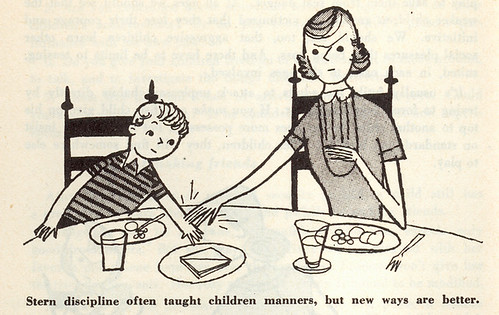
5. Here is a parent teaching her child manners so that he does not grow up to be an unseemly man.
Provincial
1. provincial (adjective)
2. province, provincialism
3. provincial: a. Characteristics of people or things away from the capital of a country. b. Limited in range or perspective; narrow; ill-informed; unsophisticated. c. Of or relating to a province. (Vocabulary for Achievement)
4. The typhoon had a much larger damage on the provincial regions, as their houses were not built with materials of good quality and many of them relied on the income from harvests, which were mostly destroyed by the deluge.
5. The provincial boy had never seen a cellphone before was shocked by the voice coming out of the small box and asked with horror: "Is someone in there?"

Mores
1. mores (noun)
2. (none)
3. mores: a. The accepted customs and rules of behavior of a particular social group, generally regarded by that group as essential to survival and welfare and often having the force of law. b. Attitudes about proper behavior; moral conventions. (Vocabulary for Achievement)
4. People who do not follow the mores of their society may suffer consequences of slight disapproval, ostracism, exile, or even death, depending on the severity of the breach of the code.
5. Most Chinese view the teachings of Confucius as the mores in Chinese society.

Ignoble
1. ignoble (adjective)
2. ignobly
3. ignoble: a. Not having a noble character or purpose; dishonorable. b. Not of the nobility; common. (Vocabulary for Achievement)
4. The ignoble salesman cheated his customers by closing down after asking them all to join the membership which had many advantages but required a hefty 500 dollar membership fee.
5. The cashier ignobly cheated the foreigner, who was unable to read the Chinese words, into thinking that the cheap and cracked porcelain bowl was an rare and expensive antique.

Glib
1. glib (adjective)
2. glibly, glibness
3. glib: a. Performing or performed with careless, often thoughtless, ease. b. Marked by a quickness or fluency that suggests insincerity. (Vocabulary for Achievement)
4. Nobody ever takes Tom's promises seriously as he always makes them glibly and never actually keeps them.
5. The presidential candidate was a fluent talker who easily persuaded many people to support him, but many people realized that he spoke glibly and that he had no intention of doing all that he'd pledged to do.

Subscribe to:
Posts (Atom)